
I have dedicated countless hours exploring online slot games, and a handful of titles garner the same immediate recognition as Starburst https://starburstdemo.eu/. This NetEnt design has become a pillar of digital casino fun, renowned for its bright gemstone design and straightforward mechanics. The free demo variant lets me test every element without jeopardizing a single penny, making it an excellent starting point for anyone curious about the game. I want to walk you through in detail how this slot functions, what renders its bonus features work, and why trying the demo first is a wise move before dedicating real funds.
The Enduring Appeal of the Starburst Slot
When I start Starburst, the first thing that strikes me is its cosmic arcade atmosphere. Glowing jewels in tones of purple, blue, orange, green and yellow float against a deep space backdrop, accompanied by a pulsing electronic soundtrack that never becomes overbearing. The design deliberately steers clear of complex narratives or cinematic cutscenes, opting instead for a clean, hypnotic aesthetic that has aged remarkably well since the game first launched. I like how this simplicity keeps my attention on the core gameplay loop rather than pulling me away with unnecessary visual noise.
Beyond the appearance, the game’s enduring popularity stems from its ability to generate frequent small wins that maintain flow. I rarely encounter prolonged dead spins, which makes sessions feel lively even when I am playing with modest bets. The two-way payline system, which I will detail later, contributes heavily to this pace. For many UK players, Starburst serves as a go-to game, a familiar title they return to when they want predictable entertainment without learning complicated new systems. That reliability is a significant part of its attraction.
I also see how the theme connects generations of slot players. The jewel-based symbols evoke classic fruit machine style, while the neon glow and space setting appeal to a modern taste. There is no gimmicky storyline to track, no character progression to access. Instead, the game offers pure, unadulterated spinning action. This focus on fundamentals is precisely why the free demo proves so valuable: I can immediately grasp the atmosphere and decide whether it matches my personal taste without any commitment.
How to Try Starburst in a Free Demo Version
Opening the free demo version of Starburst is simple and needs no sign-up or software installation. I head to a site that hosts the official demo from NetEnt, and the game opens right away in my browser. The demo offers a virtual balance of play money that I can replenish at any time, allowing me to test multiple stake levels and tactics without any real-money exposure. This setup is the same as the real-money version in terms of gameplay mechanics, RTP behavior and how features work, so I receive an accurate preview of the entire game.
Accessing the Demo Without Registration
I appreciate that the demo does not ask for my personal information, email or payment details. The game starts with a simple click, and I am immediately presented with the standard five-reel layout and a healthy play-money balance. If I use up the play money, I can just refresh the page to reset the balance. This hassle-free access makes the demo an excellent educational tool for beginners who wish to learn the mechanics before they try a regulated UK casino. I highly advise devoting at least fifteen minutes in demo mode to learn the payline behaviour and wild mechanics.
This demo interface reflects the real-money version exactly, offering the autoplay function and the quick-spin option. I can set loss limits and single-win limits within autoplay, which assists me develop responsible bankroll management habits even when no real cash is involved. The sound effects, animations and win celebrations are all present, so nothing seems watered down. For me, this transparency is a sign of a developer confident in its product, and it enables me create an honest opinion before I decide whether to deposit.
What precisely the Demo Shows About Game Rhythm
Using the free version demonstrates the game’s tempo in a way that reading about it cannot. I see how frequently the win-both-ways mechanic produces small returns, and I get a tangible feel for the average gap between wild appearances. The demo enables me experience the re-spin chain multiple times, which develops my understanding of how expanded wilds interact with the paylines. I also realize that chasing the three-wild scenario is not a viable short-term strategy; it takes place infrequently, and the demo’s unlimited balance stops me from developing unrealistic expectations about its frequency.
I employ the demo to try how different bet sizes influence my session length. With a 0.10 stake, a 1,000-coin virtual balance endures for hundreds of spins, while a 10.00 stake consumes the same balance much faster. This practical experiment aids me set a sensible budget for real-money play later. The demo also verifies that the autoplay feature behaves consistently, stopping when my preset limits are reached. I discover this kind of hands-on learning far more effective than simply reading a review, and it requires nothing but a few minutes of my time.
The Starburst Wild icon and the Re-Spin System
The wild symbol is the centrepiece of Starburst’s bonus features, and it is the unique special symbol on the reels. It appears as a multi-coloured star and can land exclusively on the three middle reels: two, three and four. When I see one appear, I know the game is about to shift into a more exciting phase. The wild substitutes for all regular symbols to complete winning combinations, but its actual power lies in the expanding and re-spin mechanic that follows immediately after it lands.
How the Expanding Wild Operates
Whenever a wild lands on reels two, three or four, it expands to cover the whole reel before any payouts are calculated. I watch the symbol stretch vertically across all three positions, turning the full reel wild. The game then evaluates wins with the expanded wild in place, which often connects multiple paylines simultaneously. An expanded wild on a middle reel can link symbols on the left and right sides, creating combinations that would otherwise be impossible. This single mechanic is responsible for the most remarkable moments I have experienced with the title.
After the growth and payment, the wild is locked in place and the game gives one free re-spin. If another wild appears on any of the other middle reels during that re-spin, it too grows, locks, and activates an additional re-spin. I can sequence up to three re-spins in total, one for each of reels two, three and four. Watching all three middle reels turn completely wild is the game’s peak scenario, and it provides a payout for every active payline in both directions, leading to a substantial total win.
Re-spin Rules and Constraints
The re-spin feature does not require any separate bonus trigger or scatter symbol. It starts organically during the base game, which I find refreshing because I never have to wait for a specific combination to unlock the excitement. The re-spins apply the same bet level and coin value as the initiating spin, so I do not need to worry about my stake changing unexpectedly. Each re-spin concludes independently, and the total win from the sequence is the sum of all individual spin payouts plus the initial wild-enhanced win.
One important limitation I have noticed is that wilds cannot occur on reels one and five. This means the greatest number of expanded wilds I can ever have on screen at once is three, and the re-spin chain ends after the third middle reel becomes wild. There is no progressive multiplier, no free spins round, and no gamble feature linked to the wilds. The entire bonus experience is contained within this elegant expanding re-spin loop. For me, this simplicity is a benefit, but I know some players long for the complexity of dedicated bonus games.
Betting Range and the Highest Payout Potential
Starburst offers a adaptable betting range that accommodates both cautious players and those who opt for higher stakes. I adjust my wager using two controls: coin value and bet level. The coin value ranges from 0.01 to 1.00 in the currency I am using, and the bet level runs from one to ten. The total stake per spin is coin value multiplied by bet level multiplied by ten paylines. At the lowest setting, I can spin for just 0.10, while the maximum goes up to 100 per spin, offering me plenty of room to handle my bankroll.
Changing Coin Value and Bet Level
I find the dual-control system intuitive once I grasp the maths behind it. Setting the coin value to 0.05 and the bet level to five gives me a total stake of 2.50 per spin. The paytable displays all wins in coins rather than currency, so I mentally multiply the coin win by my coin value to determine the actual payout. This indicates a 250-coin win for five sevens turns into 12.50 at that coin value. The demo enables me experiment with different combinations to see how the bet size affects the pace of my balance without any real-world consequence.
The bet level control basically multiplies the coin value, and I utilize it to fine-tune my wager when I want to increase exposure without jumping to a higher coin denomination. If I select coin value to 0.50 and bet level to one, my total bet is 5.00. Increasing the bet level to four at the same coin value pushes the stake to 20.00. This granularity is helpful for players who use progressive betting strategies, though I always remind myself that no betting system modifies the underlying RTP or volatility.
The 500x Stake Win Cap

The maximum win attainable in a single spin and its associated re-spin sequence is capped at 500 times the total stake. If I am playing at the maximum bet of 100, the absolute ceiling lies at 50,000 coins, which amounts to 50,000 in the relevant currency. This cap applies to the combined outcome of the initial wild-triggered spin and any subsequent re-spins that follow. I have never individually hit the full 500x, but the three-wild scenario comes close and typically returns between 200x and 400x based on the symbols aligning on reels one and five.
It is essential to realize that the 500x cap is not a progressive jackpot and does not grow over time. The figure is fixed, and the game’s low-medium volatility means that wins close to this limit are infrequent. I view the cap as a useful reference point rather than a objective to seek. The demo mode lets me to test thousands of spins and see how often larger wins appear, giving me a accurate sense of the game’s payout distribution before I contemplate playing with real money.
Comprehending the Player Return and Volatility Profile
I always examine a slot’s mathematical model before I commit real money, and Starburst offers a clearly stated return to player percentage of 96.09%. This figure indicates the theoretical long-term payout across millions of spins, and I view it as a benchmark rather than a guarantee for any single session. The RTP sits comfortably within the industry average for modern video slots, meaning the house edge is neither unusually generous nor particularly steep. When I play the free demo, I can observe how this theoretical number converts into actual gameplay rhythms without financial exposure.
Volatility, or variance, defines how often and how large the wins tend to be, and Starburst belongs squarely into the low-to-medium category. In practice, this means I encounter a steady stream of smaller payouts that keep my balance relatively stable over short sessions. I rarely face the extreme swings that characterise high-volatility games, where long losing streaks can suddenly break with a massive win. This profile makes the slot especially ideal for players who prefer extended playtime and avoid the anxiety of watching their balance plummet between rare big hits.
The interplay between the 96.09% RTP and the low-medium volatility produces a specific player experience that I have come to enjoy. The win-both-ways mechanic boosts the hit frequency, so I see winning spins roughly every third or fourth turn on average. These wins are typically modest, often returning between 0.5x and 5x my stake, but they build up steadily. The trade-off is that the maximum win potential is capped, which I will address later. I find this balance transparent and transparent, and the demo lets me test whether it suits my personal risk tolerance.
Columns and Lines: How the Slot Layout Functions
The Starburst game board uses a typical five-reel, three-row setup that will appear instantly familiar to everyone who has tried a video slot in the past. What sets it apart, however, is the payline arrangement and the direction in which winning combinations are evaluated. I find that grasping this design completely changes how I interpret every spin conclusion, so I want to detail it in concrete terms. The interface shows ten set paylines, and I cannot change that number, which implies every spin encompasses all possible line arrangements.
The Both Directions Payout System
Unlike traditional slots that only payout from left to right, Starburst grants wins when identical symbols appear on adjacent reels starting from both the first or the far right reel. If I line up three identical symbols on reels three, four and five, I collect a reward just as I might for a sequence on reels one, two and three. This practically doubles the number of chances I have to build a successful line on any specific spin. I consider this the single important functional aspect because it greatly affects the game’s hit occurrence.
The win-both-ways mechanic guarantees I do not have to fret about which side a combination starts from. When I see matching symbols clustered in the centre, I know the game will check both directions independently. The highest win per payline is paid, and if I have simultaneous wins from left and right on the same line, the larger amount applies. This system eradicates the frustration of seeing a perfect combination sitting on reels four and five with nothing on the left, a scenario that would be worthless in a one-way slot.
Icon Values and Prize Framework
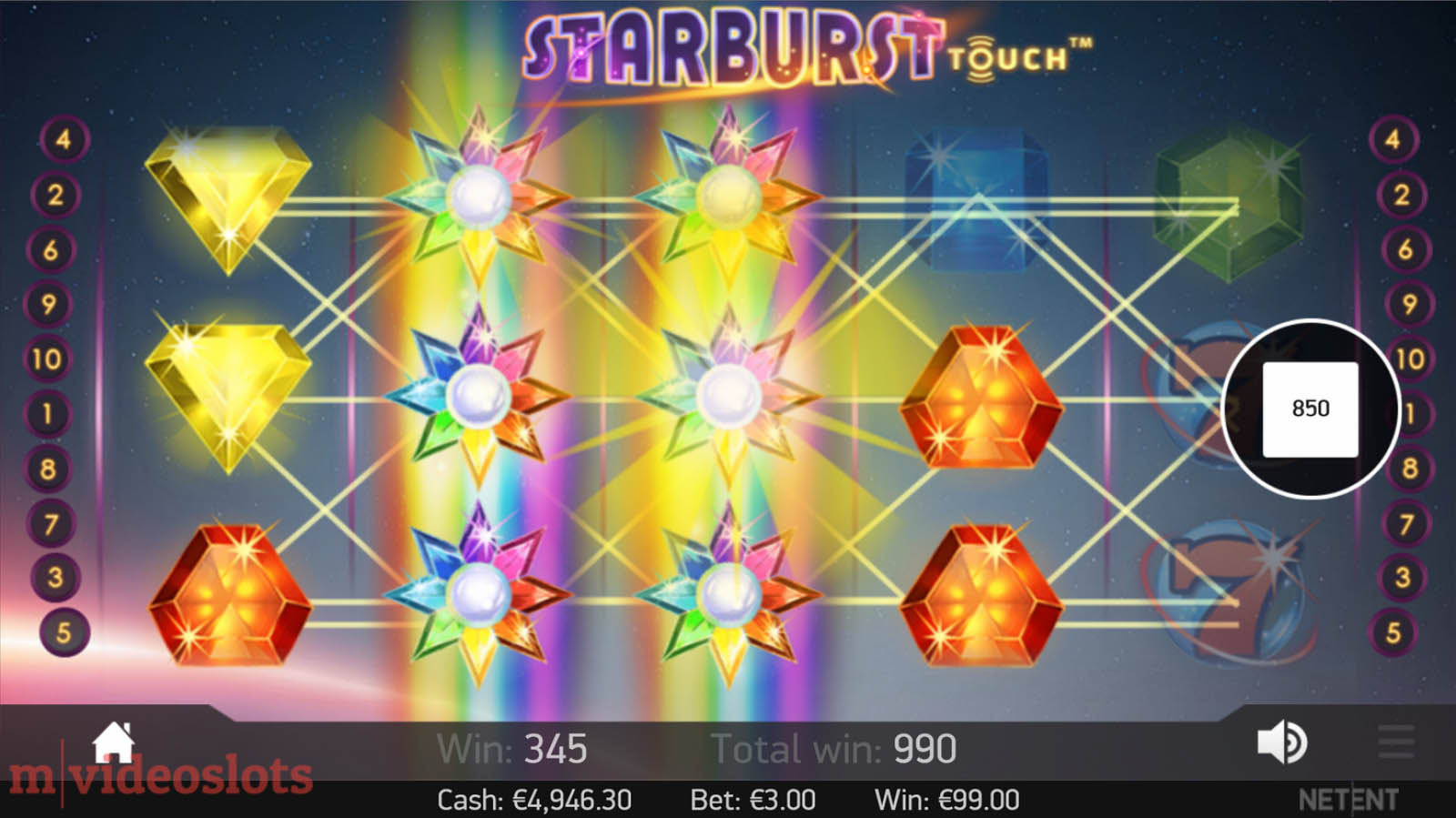
The paytable includes eight regular symbols divided into two groups. The high-value set consists of the BAR icon and the lucky number seven, both rendered in the same glowing jewel style as the rest. The lower-value symbols are five coloured gems: purple, blue, orange, green and yellow. I always check the paytable before playing because the seven offers the largest reward, paying 250 coins for five on a payline. The purple gem is next at 120 coins, while the yellow gem stands at the bottom with a 25-coin payout for five of a kind.
Because wins pay both ways, the real value of each symbol is higher than the raw numbers suggest. A full line of sevens across all five reels pays in both directions, though the game caps the payout to the highest single win on that line. I find that the BAR symbol, paying 200 coins for five, often contributes meaningfully to my balance during longer sessions. Knowing these values helps me identify which spins have delivered a strong result even when the total win appears modest at first glance.
Device Compatibility and User Experience on Multiple Devices
Starburst was created using HTML5 technology, which means I can try it on a phone, tablet or desktop computer without installing any additional software. The game automatically adjusts its layout to fit my screen size, and the touch controls on mobile devices are reactive and well-spaced. I have tested the demo on an iPhone, an Android tablet and a Windows laptop, and the performance remains uniformly smooth across all three. The visual quality does not degrade on smaller screens, and the jewel symbols retain their crisp, glowing edges.
The mobile interface moves the spin button to a visible position at the bottom centre of the screen, where my thumb naturally lies. The bet adjustment controls are placed into a collapsible menu that I can open with a single tap, keeping the main game area clean. I appreciate that the autoplay settings are equally available on mobile, because I sometimes choose to let the reels spin automatically while I study the patterns. The quick-spin feature, which speeds up the reel animations, is also accessible and helps me keep a faster pace when I want to see more results in a shorter time.
Battery consumption and data usage are reasonable, which matters to me when I play on a mobile connection. The game does not stream video or demand constant high-bandwidth assets, so it runs smoothly even on older devices. I have encountered no crashes or freezes during my demo sessions, and the re-spin animations play without stuttering. This technical dependability is a key reason I feel confident recommending the demo to players who primarily use their phones for entertainment. The experience is not a reduced version; it is the full game, adjusted for the device in my hand.
Landscape mode provides a wider view of the reels, but portrait mode works perfectly well and is often more practical for one-handed play. I can toggle between orientations instantly, and the game reloads itself without reloading. The sound can be toggled on or off with a speaker icon, and the volume adjusts separately of my device’s media settings. These small quality-of-life details lead to a sleek user experience that has kept Starburst current years after its initial release. The demo lets me confirm all of this on my own hardware before I ever consider a real-money session.