
I’ve devoted countless hours playing slots, and if there’s one number I always check before spinning, it’s the RTP https://chicken-cross.eu/. That little percentage influences everything, from how long my bankroll lasts to which bonus features actually deliver. When I first opened Chicken Cross Game, I was curious not just about its cheerful farmyard antics but about the math running beneath the surface. Gameplay seems lively with hens, foxes, and rickety roads, yet the return to player figure is what steers the experience. I want to explain exactly how RTP works in a slot like Chicken Cross Game, why volatility is important just as much, and how all the moving parts, from scatter symbols to free spin multipliers, link to that foundational percentage. By the time we’re done, you’ll examine that little information button on any slot with fresh eyes and a sharper strategy.

1) What RTP Indicates in a Slot Game
RTP, or player return, is the theoretical portion of all wagered money a slot is intended to pay back over a huge number of spins. A 96% RTP implies that for every $100 bet combined, the game will return $96 in wins over the long term. That “long term” is essential — your next twenty spins can do any number of things, and RTP isn’t a commitment for a short session. In Chicken Cross Game, the provider configures the RTP within a range you can confirm from the game’s rules overlay. I pop open the paytable or info screen and grab the exact figure because even a single percentage point directly shifts how forcefully the house edge reduces my balance.
When I try a game like this, I keep in mind that the RTP figure already includes all feature payouts, base game hits, and jackpot mechanics. That indicates the free spins, wild multipliers, and any pick‑and‑click rounds are part of that number. If Chicken Cross Game lands at 95% RTP instead of 97%, that gap accumulates every hour I play. Plenty of players chase features without checking RTP, which is like driving without a peek at the fuel gauge. I make a point to identify the RTP, jot it down, and then determine whether the entertainment value and volatility work well for my session length before I place my first bet.
6. and RTP Strategy
Chicken Cross Game provides a bet range that welcomes conservative players and those who prefer a bit more excitement. I typically spot a minimum spin around $0.20 and a maximum that can go as high as $100 in some setups, though I always confirm the exact limits inside the provider’s paytable. The link between bet size and RTP is delicate but crucial: the RTP percentage itself never alters just because I raise my wager, unless the game has a cap that modifies feature behavior at higher bets. In most configurations, a $0.20 spin and a $20 spin both get treated to the same 96% RTP over the long term, but the dollar variance you notice makes a massive effect to your gaming session.
I plan my bets around the volatility. Because Chicken Cross Game aims for medium‑to‑high risk, I choose a wager that lets me last at least 150 to 200 spins without hitting a major feature. That way, I’m still in the game when free spins finally kick in. I also keep an eye out for “feature bet” options in some variants, where you wager an extra cost per spin to raise your chance of landing the bonus. While this can reduce dry spells, it sometimes carries a slightly different RTP structure, so I always review the rules. My personal principle: never bet an amount where a string of fifteen dead spins makes you stress. Choosing a conservative unit size that aligns with the game’s RTP and variance ensures I’m operating with the slot’s math, not wrestling it.
8. Top Win Capability and What It Means for RTP
Every time I evaluate a new slot, I examine the maximum win figure because it shows how the top end of the payout curve is built. Chicken Cross Game sets its max win at a multiple of your stake that typically lies between 5,000x and 10,000x, depending on the version. A 5,000x max implies a $1 spin could theoretically yield $5,000 from a single feature sequence. This ceiling matters for RTP, because extreme jackpot potential gets funded by cutting a fraction from the base game payout rate. In other words, a sliver of that 96% RTP is parked in the remote chance of hitting the max win, something that may not appear in thousands of individual sessions.
I think this dynamic is reasonable, but it also implies the average player’s session RTP can deviate far from the theoretical number unless they achieve a life‑changing multiplier. Some Chicken Cross Game editions may use a fixed jackpot in the bonus round instead of a multiplier‑only system, so check the jackpot section in the paytable to learn if the prize is progressive or fixed. Progressive jackpots direct a tiny cut of every bet into a shared pool, which can lift the RTP slightly once the jackpot swells, but they also bring more dead spins to the base game. Since the max win is part of the RTP calculation, I never expect to experience the headline RTP in a couple of hours. Instead, I appreciate the game for its features and view any monster win as a delightful surprise, one that’s mathematically accounted for.
4. A Farmyard Theme plus Base Game Loop
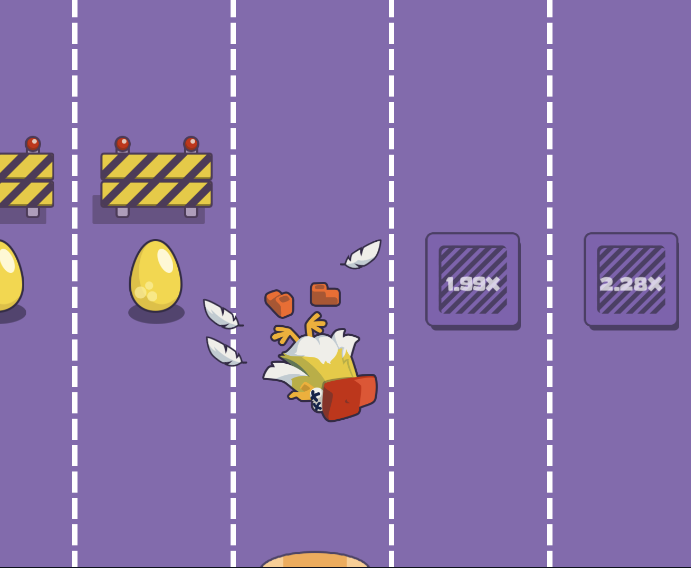
As soon as Chicken Cross Game opens, a sun‑bleached roadside scene shows up, full of hay bales, tyres, and a sasy rooster. Hens act as the premium symbols, while lower‑value icons comprise nest‑fresh eggs and rustic playing‑card suits carved into wooden boards. I adore how the theme adds personality everywhere: a fox darts across the screen for a wild animation, and the road can glimmer during a respin feature. The audio has a bluegrass twang that never becomes grating even during marathon sessions. This cohesive theme is more than paint a picture; it helps me track the game’s rhythm because visual cues alert me when a feature is near.
In the base game, my goal involves land at least three matching symbols on adjacent reels. Small wins pop up often enough to keep the balance ticking over, especially when the lower‑value symbols connect. The real heartbeat, though, rests in the chicken crossing bonus symbol. When it appears on the right reels, the game shifts. I find the base loop is built to build anticipation: hens amble across the road, and every scatter that lands seems like a step closer to a free spin sequence. Because the RTP factors in both base game and feature returns, I never judge the slot solely by base hits. I realize those quieter stretches are simply the machine holding onto its payout energy for the feature rounds ahead.
2. How Chicken Cross Game’s Risk Level Defines the Journey
RTP shows the long‑run payout share, but variance — or variance — explains how that payout is spread. High‑volatility slots award less frequently but deliver chunky wins when they do; low volatility scatters smaller prizes far more frequently. Chicken Cross Game leans into a medium‑to‑high volatility profile, thanks to its bonus structure and the way the base game produces occasional dead spins that get interrupted by lively feature blasts. The base game may remain calm for a stretch, but once those free spins activate, the payout potential jumps because of multipliers and expanding wilds.
Understanding the volatility frames my approach. I observe players grow impatient after thirty spins without a decent line hit, but that’s exactly how a medium‑high variance slot operates. The RTP remains stable over millions of spins, so those quiet stretches are simply the game hoarding payouts it will later unleash in a burst. I see it like a road trip: long empty stretches, then a barn dance at the end. I adapt my bet size to fit that rhythm, using smaller steady bets to survive dry spells, then I make a mental note to protect profits when a feature multiplier hits. If you need constant feedback, the volatility may seem a touch pokey, but if you appreciate building toward a rewarding bonus, the slot’s design will fit you snugly.
5. Special Functions That Drive Greater Victories
Should the primary game acts as the motor, the special functions act as the boost in Chicken Cross Game. The marquee element involves a free spin phase you trigger by getting several scatter icons, typically the chicken crossing icon, at any spot along the reels. Based on how many scatters appear, I can collect from 8 to 15 opening free spins. What excites me is the multiplier value used in these spins. A progressive multiplier factor can climb by a single point after each winning combo, keeping the phase exciting and satisfying. More than once, a sequence of small wins inside the free spin has built up a multiplier that turned a small hit into a bankroll‑boosting prize without harming the overall RTP setup.
The game might also include a “crossing wild icon” mechanic whereby a fox character or hen character grows to occupy a entire column, increasing the ways to win. Certain versions of Chicken Cross Game include a risk feature after any qualifying payout, giving me the chance to try to multiply by two the payout by guessing the colour or suit of a face‑down card. I almost always skip it since the gamble feature typically functions on an RTP under the primary game, eating into the game’s stated payout if I use it too hard. I treat the bonus functions like the game’s inherent system for delivering its RTP; they are not additional generosity, they represent integrated elements. Keeping that in mind keeps me from pursuing bonuses with large stakes under the impression that the machine owes me a bonus feature.
7. The way Scatters and Wilds Activate Greater Payouts
Scatters and wilds are the perfect pair in Chicken Cross Game, and recognizing how they work differentiates a clever player from a button‑masher. The scatter symbol, usually the wooden sign with a hen print, rewards no matter its position and acts as the only key to the free spins round. Get three anywhere and the screen darkens before displaying your free spin count. Some variants award a scatter payout that gets increased by the total bet, delivering an immediate boost even before the free spins start. I always check the paytable for that detail, because an instant scatter reward offers my balance a convenient cushion.
Wilds, meanwhile, intervene for absent regular symbols and commonly bring a twist. In Chicken Cross Game, a wild may appear with a multiplier or grow to fill a reel when the road turns golden. During the base game, expanded wilds often create multiple winning ways all at once, starting a cascade of smaller payouts that build up nicely. What I value most is that wilds never replace scatters, so there’s zero doubt about starting the feature by mistake. The interplay between scatter‑triggered rounds and wild‑boosted base game hits is what stamps the slot with character. I consider scatters as the long‑term goal, wilds as the backup team, and together they offer the RTP through a blend of regular line hits and occasional feature bursts rather than one dull payout pattern.
3. The Reel Layout and Paths to Win
Chicken Cross Game employs a common grid, five reels and three rows, though I always double‑check the official paytable for confirmation. What sets it apart is how it handles winning combinations. Instead of fixed paylines, the slot gives payouts when matching symbols land on adjacent reels from left to right. This “ways to win” mechanic can present between 20 and 50 active paths depending on the configuration, and sometimes that number increases during bonus rounds. I favor this over rigid paylines because every symbol position matters, and there’s no confusion about corner‑to‑corner matches.
The grid itself rests on a cracked country road, with symbols like hens, eggs, foxes, and wooden signs covering the reels. I pay close attention to how special symbols such as scatters and wilds work with the win‑ways. A wild subs for any standard symbol but never counts toward scatter‑triggered features. Since there are no paylines to buy, I just set my total bet and let each spin activate all available ways. That simplicity enables me to concentrate on symbol frequency and feature triggers instead of counting lines. Whenever I discuss with other players, I recommend them to check the paytable for the exact ways count and any expansions, because those details directly affect how often the game operates close to its theoretical RTP.
9. Useful Tips for Mastering Chicken Cross Game
I begin each session with a list that puts the RTP and volatility to work for me. I check the info screen and jot down the exact RTP, volatility label, and number of ways. Then I set a session budget equal to at least 200 times my base bet, so I can handle the variance without shortening the fun short. Before I spin for real, I try 10 to 15 demo rounds, if available, just to observe how often scatters land and how wilds behave. That offers me a feel for the dry‑spell rhythm that no paytable table can convey. Once I’m comfortable, I begin with the minimum bet and refrain from the urge to double my stake after a few losses. That’s the fastest way to commence dismissing RTP as a useless number.
While I play, I monitor my balance against my starting point and use these strategies:
- Finish the session when you’re up 30–50% of your session bankroll, because the slot’s RTP will gradually draw your balance back toward the house edge.
- If free spins trigger early, think about lowering your bet a bit to secure the winnings, then raise it again once your balance settles.
- Skip the gamble feature if its return percentage indicates lower than the base game’s RTP; the paytable usually includes that number.
- Examine the game rules for any “feature buy” option, and work out if the cost of buying the feature matches or exceeds the expected payout based on the RTP.
I always remind myself that RTP is a long‑run average, not a session prophecy. Chicken Cross Game is designed to entertain with its mischievous fox, frantic clucking, and sudden bursts of free spins. My job as a player is to comprehend the numbers beneath the surface so I can savour the ride without misreading what the percentage actually provides. When I view RTP as a planning tool rather than a guarantee, each session becomes a combination of smart bankroll management and genuine enjoyment, with a slot that recognizes exactly how to marry theme and math.